Solve it yourself
JETbot walks employees through common IT problems using the manuals for the devices JET uses.
A physical prototype of a chatbot for Just Eat Takeaway.
In collaboration with



01The challenge
Every employee at Just Eat Takeaway.com's headquarters had to have their laptop upgraded from Windows 10 to Windows 11. They brought it to the IT service desk, and the update took 30 minutes. Without a laptop, they couldn't work. The problem had a name: “The Wait”.
Find a way for employees to spend those 30 minutes usefully, ideally as internal marketing for the IT service desk.
We had a few weeks to turn this into a quick, working prototype. In meetings with JET's IT department we explored the problem and pitched our ideas.
02The idea
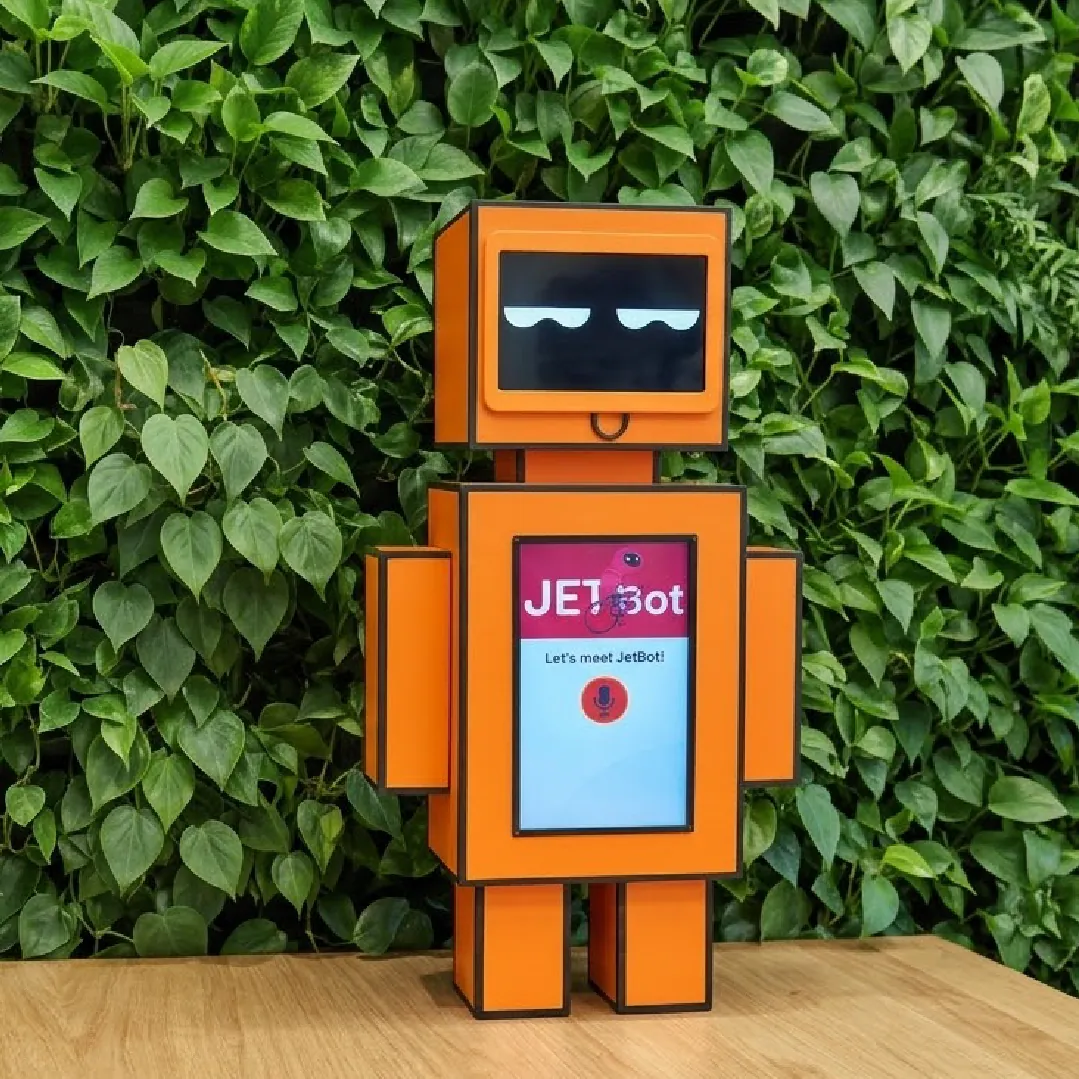
Our answer: a chatbot that helps employees troubleshoot their own IT problems, so they don't have to file a ticket straight away. And instead of another app, we made it a physical robot that stands where people wait.
JETbot walks employees through common IT problems using the manuals for the devices JET uses.
If it can't help, JETbot creates a ticket for the service desk with all the information it needs.
A large robot in JET orange draws attention during the wait, and puts the service desk in the spotlight.
03The build
We laser-cut the robot's body from wood and finished it in JET's orange, so it's recognisable from across the office.
We took apart an old laptop: its screen became the robot's chest, with the motherboard and disk inside the body. An old tablet became the head, with eyes that react to what JETbot is doing.
The interface and back end are written in Python. OpenAI's APIs handle speech-to-text, the language model and text-to-speech. The model gets a library of manuals and instructions for JET's IT devices.
04Evaluation
We evaluated the final prototype with a group of employees at JET's headquarters, the people who would meet JETbot while waiting for their laptop.